PFAS in Stormwater: The Pathway That Bypasses Treatment
Peer-reviewed research from Swedish urban streams and DoD-funded US field studies shows that stormwater mobilizes PFAS at concentrations up to 4.5 times higher than dry-weather flows, introduces compound classes invisible to standard monitoring programs, and drives precursor transformation inside retention ponds that conventional infrastructure cannot address.

Groundwater plumes move slowly. They can be modeled, pumped to the surface, and tracked over decades. Stormwater works differently. It collects PFAS from every impervious surface in a catchment, accelerates into drainage channels, and reaches downstream receptors within hours. It also carries compound classes that standard dry-weather sampling programs systematically miss. Three peer-reviewed studies published between 2024 and 2025, drawing on data from Swedish urban streams and US Department of Defense field sites, document how stormwater functions as a fast-moving, poorly regulated PFAS transport pathway, and why that distinction matters for remediation programs, municipal stormwater engineers, and DoD site managers.
What a Rain Event Releases
A 2024 study published in Water Research by Kali and colleagues evaluated three Swedish urban streams over 16 months: Fyrisån in Uppsala, Ljurabäck in Norrköping, and Storån in Söderköping. Each stream receives stormwater through a separate sewer system, with runoff discharging largely untreated to the receiving waterway. The research team collected water samples during both dry weather (less than 1 mm of precipitation) and wet weather (more than 3 mm of precipitation or snowmelt) between June 2022 and October 2023, and analyzed 34 targeted PFAS compounds (Kali et al., 2024).
What happens during a rain event is not dilution. It is mobilization.
Median total PFAS concentrations were 1.7 to 4.5 times higher in wet-weather samples than in dry-weather samples across all three sites. The highest single wet-weather measurement was 102.3 ng/L total PFAS, recorded downstream of an urban area in Norrköping. Under dry weather, 13 of 34 targeted compounds were detected. Under wet weather, that number rose to 17 of 34, including several compounds that were absent from every dry-weather sample (Kali et al., 2024).
PFOS and PFOA were the most frequently detected PFAS in both conditions: present in more than 80% of dry-weather samples and 100% of wet-weather samples. Their persistence across conditions reflects the long history of use of these compounds rather than active industrial release. Concentrations grew substantially with rainfall regardless. PFOS exceeded the EU Annual Average Environmental Quality Standard of 0.65 ng/L by 2 to 8 times under dry conditions and by 1.4 to 29.7 times during wet weather (Kali et al., 2024).
| Metric | Dry Weather | Wet Weather |
|---|---|---|
| Median total PFAS, ng/L (site range) | 1.42 – 14.91 | 2.66 – 67.8 |
| PFAS compounds detected (of 34 targeted) | 13 | 17 |
| PFOS vs. EU AA-EQS (0.65 ng/L) | Exceeded by 2 – 8× | Exceeded by 1.4 – 29.7× |
| Sum PFAS (PFOA-eq) vs. EU AA-EQS (4.4 ng/L) | Below at most sites | Exceeded by 2.6 – 22.9× at Norrköping and Uppsala |
Source: Kali et al. (2024), three Swedish urban streams, June 2022 – October 2023.
The conventional wastewater treatment plant at Uppsala contributed a consistent increase of approximately 3 ng/L to stream PFAS concentrations under dry base flow conditions. During wet weather, the stormwater contribution was more pronounced and more variable than the WWTP baseline (Kali et al., 2024). When it rains, the treatment plant discharge becomes a minor fraction of the total PFAS load entering the stream.
Where Urban PFAS Come From
The Kali study documents a range of diffuse urban PFAS sources that persist in catchments where major industrial use has been curtailed. Atmospheric deposition transfers fluorinated compounds from distant industrial emitters and consumer products onto rooftops, pavement, and vegetated surfaces. Building materials, including roofing membranes and treated siding, release fluorochemicals during rainfall. Traffic-related sources, particularly hydraulic fluids and lubricant oils, contribute several long-chain PFAS compounds. Prior research has associated the long-chain PFCA PFUnDA specifically with automotive lubricants; the Kali study found it predominantly in wet-weather samples, consistent with particle-bound transport driven by runoff (Kali et al., 2024).
At US contaminated sites, the source inventory is broader and better documented. A 2025 study published in Remediation Journal and funded by the US Department of Defense through SERDP identifies several pathways by which PFAS enter stormwater at AFFF-impacted installations: PFAS in eroded soil (dissolved, colloidal, or sediment-attached); PFAS on concrete and asphalt surfaces; mobilized sediment and particulates carrying sorbed PFAS; biosolids previously applied to land within the drainage area (see our analysis of PFAS in biosolids and land-applied sewage sludge); PFAS-containing foam dispersed by wind and deposited on surrounding surfaces; PFAS in precipitation as a background contribution; and groundwater baseflow carrying dissolved PFAS directly to the surface water system. At a PFAS-impacted DoD installation, multiple pathways may be active simultaneously (Newell et al., 2025).
The scale of the US PFAS site inventory places the stormwater pathway in context. An estimated 60,000 PFAS-impacted sites exist in the United States. As of 2025, the Department of Defense has identified 589 installations with sites currently in or entering the Remedial Investigation phase (Newell et al., 2025).
The Compound Shift Under Wet Weather
The composition of stormwater PFAS changes with rainfall in ways that standard monitoring schedules do not capture. Under dry-weather base flow conditions, short-chain PFAS, specifically PFHxA, PFHpA, PFBS, and PFHxS, are the most prevalent compounds in the stream. Their lower hydrophobicity keeps them mobile in the dissolved phase regardless of weather. When rain begins, the compound profile expands significantly.
Under wet weather, long-chain perfluorocarboxylic acids (PFNA, PFDA, PFUnDA) and the precursor compound 6:2 FTS became more frequently quantified across all three study streams. Two compounds, PFUnDA and PFBA, were absent from all dry-weather samples but appeared at all monitoring locations during wet-weather events. Two additional compounds, 8:2 FTS and EtFOSA (a long-chain sulfonamide associated with particle-bound transport), were detected exclusively under wet-weather conditions (Kali et al., 2024).
The behavior of 6:2 FTS is particularly informative. This compound is a recognized marker of aqueous film-forming foam use at military installations and airports. It was absent from dry-weather samples at sites downstream of airports that had discontinued PFAS-based firefighting foam but appeared during runoff events at other urban locations. Its presence in wet-weather but not dry-weather samples indicates it is reaching streams through particle-bound stormwater transport rather than dissolved groundwater discharge. A dry-weather monitoring program would not detect it (Kali et al., 2024).
Fluorotelomer sulfonates, including 6:2 FTS and 8:2 FTS, are not currently subject to US regulatory limits. The Kali study notes that these compounds can degrade into more persistent terminal PFAS including PFOA and PFOS, and identifies the need for regulatory action on these precursors (Kali et al., 2024). For treatment implications of the short-chain fraction that dominates dry-weather base flow, see our analysis of short-chain PFAS treatment challenges.
Sediment as a Long-Term Reservoir
Stormwater does not only carry PFAS in solution. It deposits them. Bottom sediment in receiving streams serves as a long-term accumulation zone for PFAS that sorb to particles during transport and settle out when flow velocity decreases after a storm.
The Kali study found PFAS in bottom sediment at all three monitoring sites. Ten compounds were quantified in Norrköping sediment, seven in Uppsala, and one (PFOS only) in Söderköping. Total PFAS concentrations in sediment ranged from 0.08 to 4.28 µg/kg dry weight in Uppsala and Norrköping and from 0.06 to 0.13 µg/kg dry weight in Söderköping. The highest concentrations appeared at sampling points near long-established point sources: the upstream Uppsala site measured 3.22 µg/kg dry weight and the downstream Norrköping site measured 4.28 µg/kg dry weight (Kali et al., 2024).
Long-chain PFCAs with carbon chain lengths from 7 to 13, along with PFHxS and precursor compounds including EtFOSAA and EtFOSE, were more prevalent in bottom sediment than in water. This reflects their higher hydrophobicity and stronger tendency to partition onto organic particles. PFOS concentrations in sediment exceeded the lowest available Predicted No-Effect Concentration of 0.012 µg/kg dry weight at all sampled sites (Kali et al., 2024).
The implication for site investigation is that stream sediment downstream of PFAS-impacted stormwater outfalls functions as a secondary PFAS source. High-flow events resuspend accumulated particles, and previously deposited long-chain compounds and precursors reenter the water column in the next storm pulse. Sediment sampling is an essential component of a complete stormwater PFAS site characterization.

AFFF Sites and Stormwater Mass Discharge
At sites where aqueous film-forming foam was used historically, stormwater PFAS concentrations reflect direct surface and soil contamination rather than diffuse urban sources. The SERDP-funded Newell et al. (2025) study compiled PFOS stormwater concentration data from nine AFFF-impacted sites across two Australian airports, two Australian DoD installations, and six US AFFF facilities. Concentrations ranged from 10 ng/L to 255,000 ng/L. The geometric mean of site median concentrations was 1,745 ng/L, far above the EPA's chronic aquatic life criterion of 250 ng/L (Newell et al., 2025).
Phase partitioning data from a monitored DoD PFAS site shows that approximately 90% of PFOA and PFHxS, 70% of PFOS, and 30% of PFOSA in stormwater were in the dissolved phase (Newell et al., 2025). This means the majority of PFAS in stormwater at AFFF sites passes through sediment filters, bypasses settling zones, and is carried as dissolved-phase contamination to downstream receptors.
For comparison, the median PFOS concentration in groundwater at 96 AFFF-impacted airport sites was 37,000 ng/L, substantially higher than the stormwater geometric mean of 1,745 ng/L. Groundwater at AFFF sites carries higher PFOS concentrations on average. But concentration alone does not determine impact.
| Pathway | PFOS Concentration | Annual PFOS Mass (Modeled) | Time to Receptor |
|---|---|---|---|
| Stormwater 9 AFFF sites |
Geom. mean: 1,745 ng/L Range: 10 – 255,000 ng/L |
Median ~0.59 g/yr Range: 0.000025 – 450 g/yr |
Hours to days |
| Groundwater 96 AFFF airport sites |
Median: 37,000 ng/L | Average ~200 g/yr 3 sites: 22, ~400, 310 g/yr |
Decades to centuries |
Source: Newell et al. (2025). Stormwater mass discharge modeled for a hypothetical 0.5-hectare AFFF site across 22 US cities.
The median stormwater PFOS mass discharge of 0.59 g/year is more than 300 times lower than the average groundwater mass discharge of approximately 200 g/year (Newell et al., 2025). By annual mass, groundwater is the dominant transport vector at AFFF sites. But speed changes the risk calculus. Stormwater can deliver PFAS to a drinking water intake, recreational contact area, or commercial fishing ground within hours of a rainfall event. A remediation program that documents groundwater as the dominant mass discharge pathway while leaving stormwater unquantified is missing a fast-response exposure vector that operates on a timeline groundwater plume models do not capture.
The Regulatory Gap
The existing regulatory framework for stormwater PFAS has not kept pace with the contamination science. The National Pollutant Discharge Elimination System (NPDES), which governs stormwater discharges at industrial facilities and municipal systems, does not include PFAS-specific monitoring requirements or effluent limits. Stormwater Pollution Prevention Plans, required at many industrial facilities under NPDES authorization, similarly lack any provisions specific to PFAS. The state-by-state regulatory patchwork developing around PFAS drinking water and groundwater standards has not extended to stormwater permitting in any systematic way (Newell et al., 2025).
Watershed-scale data illustrates what this gap means at the mass balance level. A published study of the Huron River watershed in Michigan, cited in the Newell et al. review, estimated total PFOS mass discharge of approximately 22 kg/year across the watershed. Approximately 75% of that load was associated with 148 potential PFAS contamination sites within the drainage basin. Leaching to groundwater was approximately 17 times higher than PFOS transported directly in surface runoff. Wastewater treatment plants and diffuse urban sources each contributed approximately 10% of the total PFOS load; surface runoff contributed approximately 13% and sediment approximately 1% (Newell et al., 2025). This type of mass balance reveals both the relative contributions of different source categories and the gap between what current monitoring requires and what a comprehensive PFAS watershed assessment would document.
Newell et al. (2025) identify four regulatory mechanisms that could begin to close the gap, listed in order from near-term to longer-term implementation:
- Expanding NPDES permits and Stormwater Pollution Prevention Plans to require PFAS monitoring
- Implementing Best Management Practices (BMPs) with defined PFAS concentration benchmarks
- Establishing individual-site stormwater mass discharge limits
- Developing watershed-scale Total Maximum Daily Loads (TMDLs) for PFAS under Clean Water Act Section 303(d)
Of existing BMPs, those with potential applicability to PFAS include source controls such as covers and flow diversion, sorption media socks or liners, constructed floating wetlands, and first-flush treatment systems. BMPs with limited effectiveness for PFAS include infiltration-based discharge controls, which risk transferring dissolved PFAS to groundwater, and conventional coagulation, flocculation, and settling, which has limited effectiveness for the dissolved PFAS fraction that dominates most stormwater (Newell et al., 2025). The ITRC's 2023 PFAS guidance identifies the TMDL process as an existing statutory mechanism for setting caps on PFAS loads in receiving water bodies (Newell et al., 2025).
What Stormwater Control Measures Actually Do
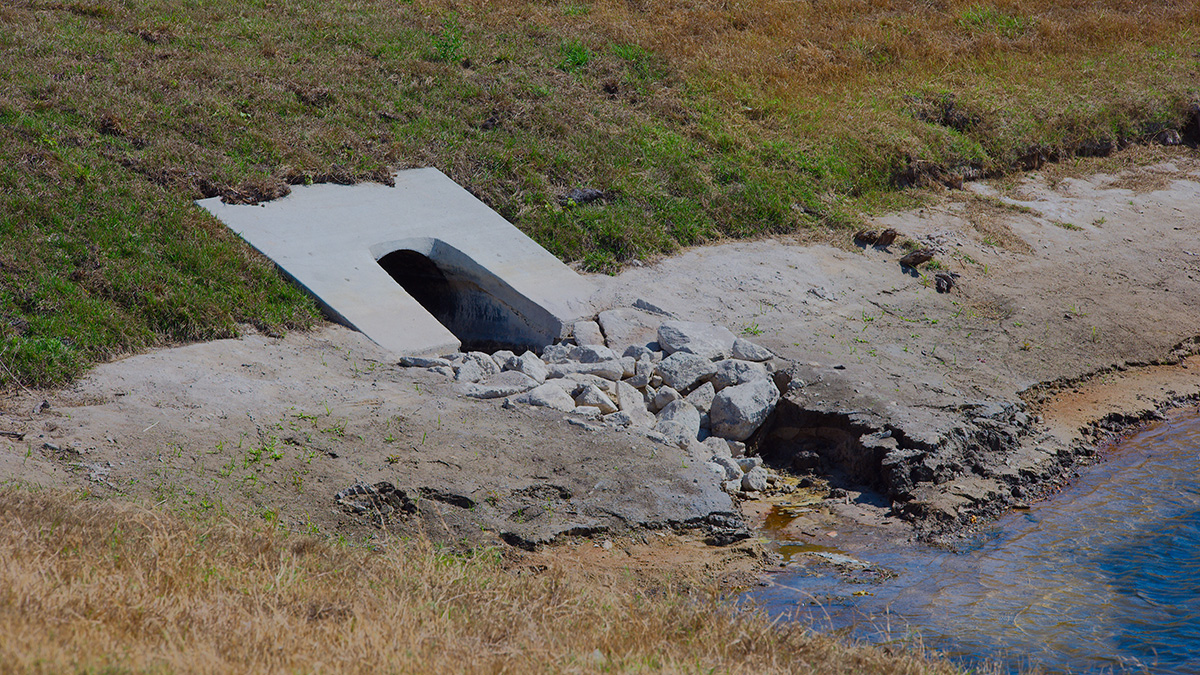
Field data on how conventional stormwater control measures (SCMs) handle PFAS were largely absent from the literature until a 2025 SERDP-funded study by Gómez-Ávila and colleagues. The study evaluated seven SCMs across three US regions: three biofilters, three hydrodynamic separators (two with downstream ZPG cartridge filters), and one retention pond. It is the first systematic field evaluation designed specifically to characterize PFAS partitioning and fate across multiple SCM types at sites with and without documented AFFF contamination (Gómez-Ávila et al., 2025).
Carbon chain length is the primary variable determining whether PFAS in stormwater are accessible to SCM treatment. PFAS with chain lengths greater than 8 carbons had median particulate-phase associations exceeding 35%, with some exceeding 70%, making them at least partially removable by settling and filtration. PFAS with chain lengths of 8 or fewer were predominantly in the dissolved phase, though 20 to 30% was still found as particulate-associated. Whether a compound is a perfluorocarboxylic acid (PFCA) or a perfluorosulfonic acid (PFSA) was not a statistically significant factor in phase partitioning; chain length dominates (Gómez-Ávila et al., 2025).
For dissolved PFAS, the central finding is that most SCMs provided limited removal. Dissolved PFAS concentrations at SCM outlets generally fell in the range of 10 to 50 ng/L. Two biofilters achieved partial reduction: one using mulch and sand/peat media reduced dissolved PFAS from more than 100 ng/L to 51 ng/L; a second reduced concentrations from 71 ng/L to 32 ng/L. A maintained hydrocyclone with a downstream ZPG cartridge filter reduced dissolved PFAS from 48 ng/L to 24 ng/L and achieved a 61% reduction in particulate-phase PFAS from 34 ng/L to 13 ng/L (Gómez-Ávila et al., 2025).
Maintenance is not a background operational factor. The unmaintained hydrocyclone system in the same study produced higher effluent concentrations than its incoming stormwater. Clogging and resuspension of accumulated solids reversed the system's performance: PFAS that had sorbed to media or settled in traps was remobilized and discharged at elevated concentrations. The maintained and unmaintained systems were otherwise identical in design (Gómez-Ávila et al., 2025).
PFAS were also detected at levels exceeding regulatory thresholds at SCM sites without any documented AFFF contamination history. Stormwater itself is a diffuse PFAS source, independent of point-source contamination (Gómez-Ávila et al., 2025). The short-chain dissolved fraction that passes through most SCMs without removal is also the fraction most resistant to conventional sorption-based treatment media.
The Problem with Retention Ponds
Retention ponds are among the most common stormwater management structures in the US built environment. They reduce peak flows, settle suspended solids, and appear in virtually every standard stormwater management plan. For PFAS-impacted catchments, their effect on dissolved PFAS is the opposite of what a treatment system should produce.
The retention pond evaluated in the Gómez-Ávila study was located in an arid region of the southwest United States, with a drainage area of 104 hectares that included a 14-hectare former aircraft parking apron adjacent to a historical AFFF use zone. Post-storm dissolved PFAS concentrations in the pond reached approximately 1,400 ng/L, the highest dissolved concentrations measured across any system in the study and approximately two orders of magnitude above the 10 to 50 ng/L range recorded at other SCM outlets (Gómez-Ávila et al., 2025).
Two processes drive these elevated concentrations. The first is precursor transformation. Precursor compounds (fluorotelomer sulfonates and fluoroalkyl sulfonamide derivatives) comprised 27 to 29% of total PFAS in the incoming stormwater. In the pond water and sediment, the precursor fraction had dropped to less than 10%. The precursors are not being removed; they are converting to terminal PFAS within the pond, driven by the long hydraulic residence time. Terminal perfluorocarboxylic acids composed more than 30% of pond surface water PFAS. Perfluorosulfonic acids including PFOS, which partition more strongly due to higher sorption coefficients, rose to 80% of pond sediment PFAS (Gómez-Ávila et al., 2025).
The second process is evaporative concentration. During the arid dry season (January through May), pond water volume decreased as evaporation exceeded inflow. Shorter-chain dissolved PFAS (PFBA, PFHxA, PFHxS) increased by approximately 50% in concentration as water volume was lost. PFOS continued settling to sediment during this period, but the shorter-chain dissolved compounds remained in an increasingly concentrated water column (Gómez-Ávila et al., 2025).
Targeted PFAS analysis understates the total PFAS load in stormwater entering and leaving retention ponds. TOP assay results from the study show that precursor oxidation can more than double the molar PFAS concentration compared to targeted compound lists. A retention pond treating inflows from an AFFF-impacted catchment may be accumulating substantially more PFAS mass than its monitoring data shows, while simultaneously generating terminal PFAS that were not present in the incoming water (Gómez-Ávila et al., 2025).
What This Means for Site Managers and Engineers
The data from these three studies point to several concrete considerations for stormwater investigation and treatment design at PFAS-impacted sites.
Wet-weather sampling is a baseline requirement, not an enhancement. A monitoring program conducted only during dry conditions misses the long-chain compounds, sulfonamide precursors, and fluorotelomer sulfonate markers that appear exclusively during runoff. These unregulated compounds degrade into regulated terminal PFAS downstream of the monitoring point. Dry-weather samples establish a floor, not a representative concentration, for site PFAS characterization.
Precursor screening must be included in sample analysis. The Kali et al. study found fluorotelomer sulfonates in wet-weather samples at sites with no documented AFFF connection. The Gómez-Ávila study showed precursors representing 27 to 29% of incoming stormwater PFAS converting to terminal compounds inside a single retention pond. Standard targeted analysis focused on regulated compounds underestimates the total PFAS burden and misses the transformation dynamics occurring inside existing stormwater infrastructure.
Retention ponds near AFFF-impacted areas require active management or treatment. A retention pond downstream of a PFAS-contaminated catchment does not attenuate PFAS. It concentrates dissolved PFAS through evaporation, transforms precursors to terminal compounds through long residence times, and stores particle-associated PFAS in accumulating sediment. Treating effluent before it leaves the pond, or diverting inflows from contaminated subcatchments before they enter the pond, is the appropriate engineering response. Treatment of the dissolved fraction, including evaluation of ion exchange and granular activated carbon for short-chain compounds, may be required for the concentrated pond water.
Maintenance schedules for sorption-based SCMs are a performance variable. The Gómez-Ávila study showed that the same system type produced improved effluent when maintained and degraded effluent when neglected. Accumulated solids in cartridge filters and sump chambers become a secondary PFAS source when resuspended. For systems handling stormwater from AFFF-impacted areas, maintenance records and media replacement logs are part of the site's PFAS control documentation.
Stormwater mass discharge should be quantified independently from groundwater mass discharge at AFFF sites. Groundwater carries substantially more PFAS mass annually at most AFFF facilities, but stormwater reaches receptors in hours rather than decades. The four-tier framework described by Newell et al. for estimating stormwater PFOS mass discharge provides a structured approach for reducing estimation uncertainty from a factor of roughly 3,600 down to less than a single order of magnitude. For sites adjacent to public water supply intakes, recreational contact water, or commercially fished water bodies, that quantification is not optional.
Stormwater has been managed as a sediment and nutrient problem for decades. Field data from DoD-funded research shows that for PFAS-impacted sites, it is something different: a fast-moving transport pathway for dissolved and particle-associated forever chemicals, a precursor transformation zone inside existing infrastructure, and a connection to receptors that operates on a timeline conventional plume models do not capture.
Sources
- Kali, S.E., Österlund, H., Viklander, M., and Blecken, G-T. (2024). "Stormwater discharges affect PFAS occurrence, concentrations, and spatial distribution in water and bottom sediment of urban streams." Water Research, 122973. https://doi.org/10.1016/j.watres.2024.122973
- Newell, C.J., Gamlin, J.D., Garvey, G.J., Rifai, H.S., Grundy, G.O., Gupta, M., Wang, M., Johnson, N.W., Javed, H., and Lentz, M.Q. (2025). "Exploration of PFAS Mass Discharge in Stormwater Versus Groundwater: Technical and Regulatory Considerations." Remediation Journal. https://doi.org/10.1002/rem.70052
- Gómez-Ávila, C., Hussain, T., Rao, B., Pitt, R., Guelfo, J., Zhou, H., and Reible, D. (2025). "PFAS distribution and fate in stormwater control measures (SCMs): Biofilters, hydraulic separators, and retention ponds." Water Research. https://www.sciencedirect.com/science/article/pii/S0043135425016987
Need Stormwater or AFFF Site Treatment Solutions?
PRM designs and deploys treatment systems for AFFF-impacted stormwater, groundwater remediation, and PFAS-contaminated water requiring removal of dissolved and particulate-phase compounds. From skid-mounted carbon and ion exchange systems to complete treatment trains handling variable stormwater flows, we build systems matched to your site conditions and discharge requirements.
Contact Our Team